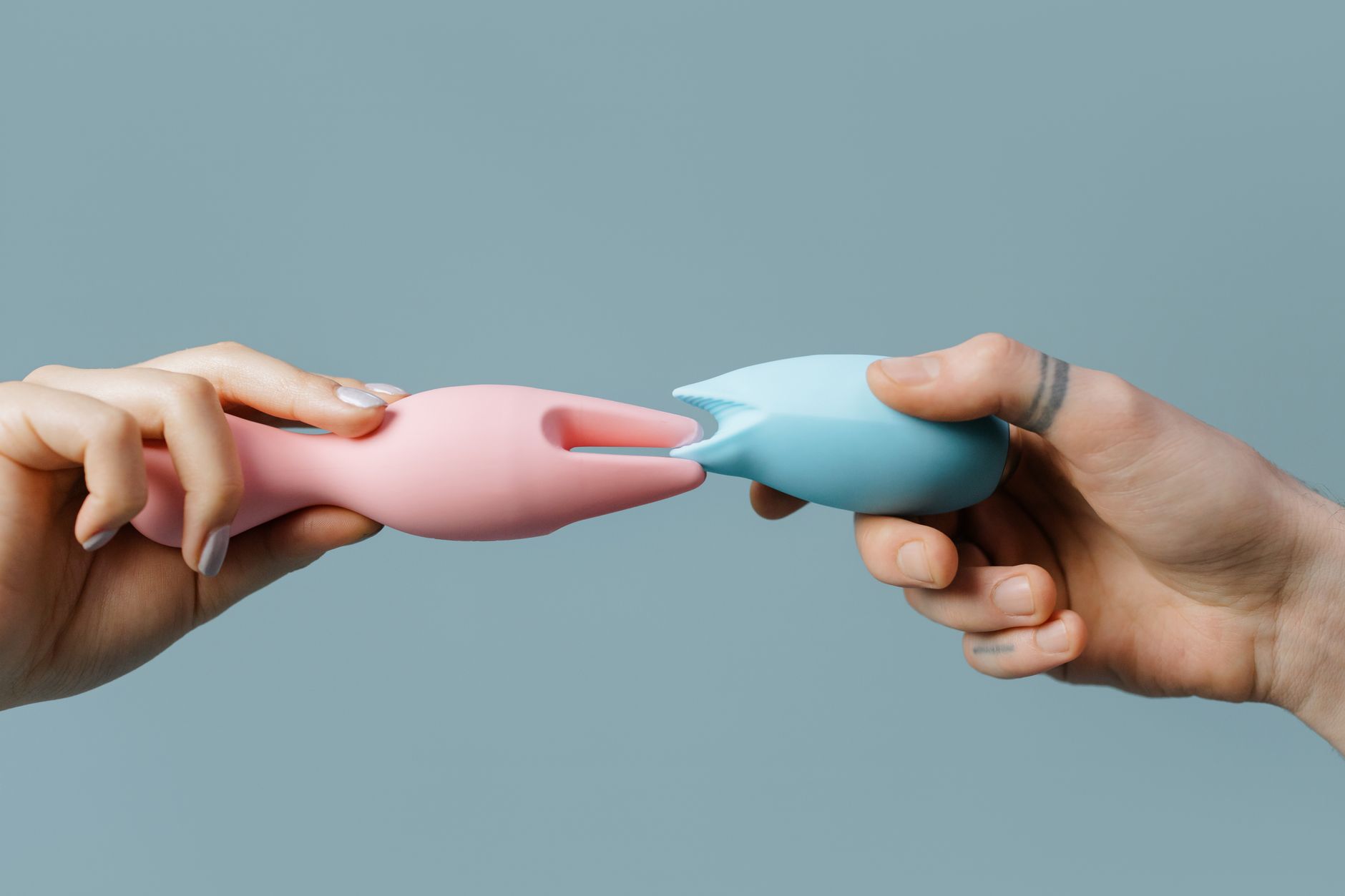
How to Use Lemon Vibrators When You Feel Disconnected From Your Body
Let's start with something I hear in my practice almost weekly: "I'm there, but I'm not really there." During sex, your body moves. Your partner touches you. Maybe you orgasm. But it feels like you're watching from outside yourself, muffled and distant, like you're experiencing the whole thing through a thick pane of glass.
That's dissociation. And it's not a character flaw, a sign you don't want sex, or proof that something is fundamentally broken. It's your nervous system doing exactly what it was designed to do: protecting you from overwhelming sensation or emotion by creating distance.
The good news is that dissociation during sex is highly reversible. And lemon vibrators, specifically their unique suction technology, offer a way back into your body that bypasses a lot of the friction and pressure that can trigger further disconnection.
What dissociation actually is (and why it happens during sex)
Dissociation isn't a sexy term, so let me be specific: it's what happens when your brain decides that the present moment is too much, and it mutes the signal. Your prefrontal cortex goes offline a bit. Your sense of self gets fuzzy. Time feels strange. You might describe it as watching yourself from above, or feeling like your limbs don't quite belong to you.
During sex, dissociation often shows up when your nervous system associates vulnerability, physical touch, or being seen with threat. Sometimes there's a clear reason. Past trauma. A current relationship dynamic where you feel unsafe. A pattern of being touched when you didn't want to be.
But sometimes there's no obvious cause. You're not traumatized. Your relationship is good. And still, mid-sex, you float away.
This happens because the nervous system is exquisitely sensitive to context. If you grew up in chaos, or if you learned to manage overwhelming feelings by leaving your body, or if you spent years disconnected as a survival strategy, that pattern doesn't just disappear when you find a safe partner. Your body doesn't know that yet.
Why lemon vibrators are particularly helpful for reconnection
Most vibrators use broad, rumbly vibration patterns. They're fine. But they can sometimes intensify dissociation because the sensation feels abstract, almost detached from your body. It's stimulation happening to you, not something you're inhabiting.
Lemon vibrators work differently. The suction technology creates a rhythmic pulse that feels more like someone touching you, building pressure and release in a pattern your nervous system recognizes as safe and grounded. It's stronger, more present, harder to dissociate through.
That focused, rhythmic sensation does something crucial: it anchors you to the present moment. Your nervous system recognizes "oh, this is real, this is now, this is mine." It's not spiritual language. It's neurobiology. The vagus nerve (which controls your parasympathetic response) lights up. Your breath deepens. You become less likely to float away.
The reconnection protocol
Here's how to use lemon vibrators intentionally when dissociation is a pattern for you.
Start solo, always. This is non-negotiable. You're teaching your nervous system that touch is safe. With a partner present, there's external pressure (their pleasure, their expectations, their pace). Alone, you can go at your own rhythm and stop the instant you feel yourself drifting.
Get into a comfortable position. Not on your back if that triggers dissociation for you. Not in a position where you feel exposed. Lying on your side, sitting propped up with pillows, on your stomach. Whatever position lets you feel grounded and present.
Turn it on at the lowest setting before you touch it to yourself. Listen to the sound. Feel it vibrate in your hand. Let your body anticipate it. This small pause signals to your nervous system that you're in control, that you're choosing this.
Apply it slowly and notice the sensations specifically. Don't think "am I turned on yet." Instead, notice: the pressure, the rhythm, the warmth, the texture. Name one thing in your body that you feel. "There's a tingle at the top of my clitoris." "My thighs feel warm." This kind of targeted noticing keeps your prefrontal cortex engaged. It's the opposite of dissociation.
If you feel yourself drifting, pause. Don't push through. Dissociation isn't something to overcome by sheer willpower. Instead, pause the vibrator. Take three slow breaths. Open your eyes if they were closed. Feel your body against whatever surface you're on. Notice one thing you can see, one thing you can hear. This is grounding, and it works.
Build sessions gradually. You might spend five sessions just letting your body accustom itself to the sensation at low settings. That's perfect. There's no timeline. You're rewiring your nervous system's response to pleasure, and that takes the time it takes.
The partner piece (when you're ready)
Once you feel more inhabit your body solo, inviting a partner in takes intentional communication.
Tell them explicitly: "I sometimes disconnect during sex. It's not about you. I'm working on it. Here's what helps." Then show them. Demonstrate the low setting. Explain that you might ask to pause mid-session. Clarify that "pause" doesn't mean "stop forever," just "give me a moment."
A partner who understands dissociation can become part of the reconnection. They might offer grounding cues between sessions: specific eye contact, a hand held over your heart, your name said aloud. These aren't sexual. They're nervous-system support.
Many couples find that using a lemon vibrator together changes the dynamic. Instead of traditional penetration (which can increase dissociation for people with a trauma history), external clitoral stimulation keeps you present, keeps your nervous system engaged, and often deepens intimacy because you're actually there in the experience together.
What to watch for
Dissociation can be linked to trauma, anxiety, or depression. If it's pervasive (not just during sex, but throughout daily life), therapy helps more than any vibrator will. A trauma-informed therapist or somatic therapist can help you identify why your nervous system goes offline and give you tools to bring it back.
If dissociation happens only in certain positions, or only with certain partners, or only in certain emotional states, that's useful information. Pay attention. Your body is telling you something about conditions you need to feel safe.
And if lemon vibrators aren't working for you after several months of patient practice, that's okay. Some nervous systems need a different approach. Some people benefit from broader, rumbly vibration instead of suction. Some need temperature play or impact play to feel grounded. Your pleasure is individual, and it's worth experimenting to find what brings you back.
The bigger picture
Dissociation is your nervous system trying to help. It's not broken. You're not broken. And reconnecting with your body isn't something that happens through willpower alone. It happens through patience, repetition, and choosing tools and partners and conditions that make it safe to be present.
Clitoral vibrators can be part of that. But they're part of a bigger conversation with yourself about what you need to feel grounded, seen, and safe during sex. That conversation is worth having, and you deserve the time it takes.
People also ask
Can dissociation during sex go away permanently?
Yes, often completely. Dissociation is a learned response, which means it can be unlearned. Most people find that with consistent nervous-system work (whether that's therapy, meditation, regular partnered sex in safe conditions, or solo practice with tools like lemon clitoral vibrators), dissociation during sex becomes less frequent and eventually stops. That said, some people with trauma histories may always have a tendency toward dissociation under stress, but they learn to recognize it and ground themselves quickly.
Is dissociation the same as not being attracted to my partner?
Not necessarily. You can be deeply attracted to your partner and still dissociate. Dissociation is about your nervous system's response to vulnerability, not about desire. That said, if dissociation only happens with one partner and not others, that's worth examining. It might point to a dynamic in the relationship that needs attention. A couple's therapist can help untangle this.
Does it matter if I use a lemon vibrator vs. another type of clitoral vibrator?
For reconnection specifically, the suction technology in lemon vibrators has a slight edge because the rhythmic pulse pattern feels more embodied than broad vibration. But honestly, the vibrator that works best is the one you'll actually use consistently. If you prefer another type, use that. The practice of solo, grounded, intentional stimulation matters more than the specific device.
How long does it usually take to feel reconnected?
This varies widely. Some people notice a shift after two or three sessions. Others take weeks or months. A lot depends on how entrenched the dissociation pattern is, whether you're in therapy addressing it, and how consistent you are with solo practice. The key is to not expect a timeline. You're rewiring your nervous system, and that works on its own schedule.
Should I tell my partner about my dissociation?
Yes, at some point. You don't have to share every detail on the first date. But when sex becomes part of your relationship, your partner deserves to know that dissociation is a pattern for you. It helps them understand that pauses aren't rejection, that slow warm-up time isn't foreplay laziness, and that your attentiveness during sex might look different than they'd expect. It also gives them permission to check in with you and become part of your reconnection practice. That kind of transparency usually deepens intimacy.
What if I dissociate with solo pleasure too?
That suggests the dissociation is more systemic and might benefit from therapy beyond solo vibrator use. A somatic or trauma-informed therapist can help you understand what's triggering it in that solitary space and give you grounding techniques that work specifically for you. Some people also benefit from breathwork, cold exposure, or body-based therapy like Somatic Experiencing or Sensorimotor Psychotherapy.
If you're struggling with consistent dissociation during sex or in daily life, reach out to a therapist or contact us at /contact for resources. You don't have to figure this out alone.